
John McDonald’s Thin Red Line
In the 1800s, Australian colonial police were gradually organising and centralising. The local forces composed of recruits generally representative of the local population, with preference given to men with service experience. John Alexander McDonald joined Brisbane Police in 1861, having married Alice Malcolm in Victoria earlier the same year (BMD VIC 716/1861). McDonald was from Nairn, Scotland. He was born on 14 April 1836 (Memorial ID 203675231). Within a year of joining the local police in 1861, McDonald was transferred to Water Police, and as was customary for recruits with a previous military record, he quickly progressed to the rank of an Inspector. Prior to migrating to Queensland, McDonald served in the British Army with the notable 93rd Sutherland Highlanders brigade, which played a key role in the battle of Balaclava (September 1854) during the Crimean War (October 1853-February 1856).
Following a bloody affray during an arrest, the Brisbane Courier described Sergeant McDonald as ‘an old Crimean warrior, having taken part in the three great battles of Alma, Balaclava, Inkermann, and the final assault on Sebastopol. In proof of this he now wears with his ordinary uniform the medals and clasps he received for services in that campaign, and also the Victorian Cross, as a special mark of distinction commemorative of his bravery in an incidental collision with the Russians’ (‘The Late Robbery at Rosetta’s Hotel’, The Courier (Brisbane), 13 Sept 1861, p. 2).
In mid-September 1854 the allied British and French forces with a small Turkish contingent, landed on the Western Crimean coast 30 miles (50 km) north of Sevastopol with the aim of capturing the neighbouring Russian Black Sea naval base. At the time Lieutenant General the Earl of Raglan was in command of the British Army with Sir Colin Campbell in charge of the 93rd Highlanders. General Saint-Arnaud commanded the French Army, while Prince Menshikov commanded the Russian Army with General Liprandi leading the Balaklava assault.
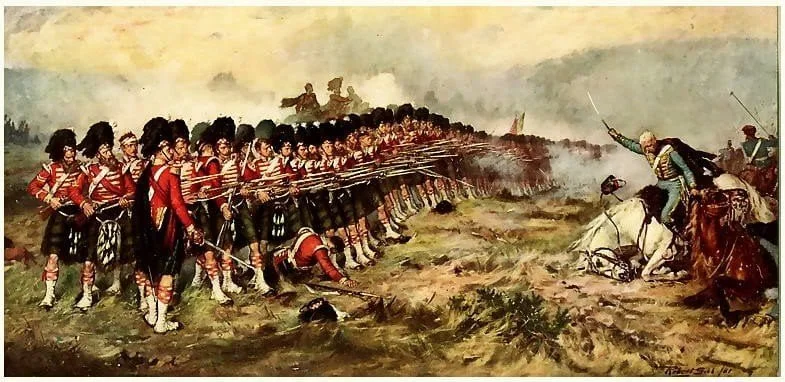
‘The Thin Red Line by Robert Gibb (1881) displayed in the Scottish National War Museum, Edinburgh Castle.
As the Russian forces began their approach, the Highlanders formed a line across the Russian imperial cavalry’s path of advance. The 93rd fired one volley at extreme range and the Russian cavalry withdrew. The Times war corresponded, William H. Russell, reported that he could see nothing between the charging Russians and the British regiment’s base of operations at Balaklava but the ‘thin red streak tipped with a line of steel’ of the 93rd (The Times 14 November, 1854 p. 7). Private John McDonald was wounded in the Battle of the Alma (1854) and again in 1855, as a Sergeant (Burgoyne, Historical Record of the 93rd Sutherland Highlanders, etc, 1883, pp. 106, 140).
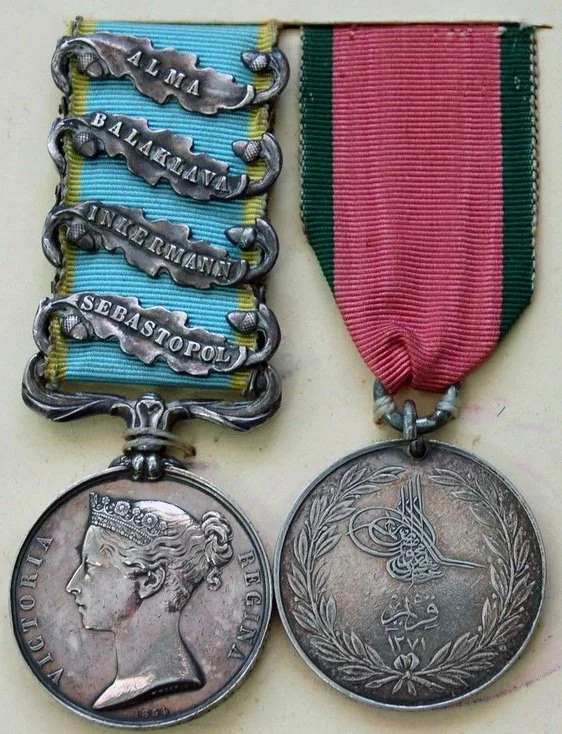
John McDonald was awarded a Crimea medal with bars ‘Alma’, ‘Balaklava’, ‘Inkermann’ and ‘Sebastopol’ and a Turkish Crimea medal for his service.
McDonald continued his heroic endeavours in the service of the Queensland Police. On 8 April 1863, the ‘Queen of Colonies’, a fine Aberdeen built clipper of 1346 tonne belonging to the Black Ball Line, arrived in Moreton Bay. She left London on Christmas Eve day 1862, with 450 passengers and emigrants on board. During the passage there were 10 deaths, as Mrs Barnsfield died while just within sight of the land it was decided to bury her on Moreton Island. Captain Robert Cairncross sent a 14 men party ashore. Having performed the burial ceremony the party embarked on their journey back to the ship. A heavy squall from the west soon after swept down the coast and struck the boat. After 18 hours the men eventually ran their craft ashore on a sandy beach close by Great Caloundra Heads. They survived on limpets and shellfish, which covered the rocks at the base of Caloundra Heads. Several days later, in a desperate attempt to escape, the men tried to launch the boat into the water but while trying to get through the breakers the boat capsized. To add to their grief Mr. Barnsfield, who has been conspicuous in his exertions to launch the boat, was seized and devoured by two sharks.
It was another fortnight before the men who camped under a few bushes on Big Caloundra Head near a fresh water lake were finally rescued by Inspector John McDonald and his search party. McDonald was later presented with a £100 Government reward and a valuable tea and coffee service worth 100 guineas, by the agent and officers of the Black Ball Line.
In 1867, soonafter Queensland Police Force was established by the Queensland Police Act 1863, McDonald was promoted to Prison Superintendent of St Helena Prison Establishment. He retired from the Force in 1882, after 21 years of commendable service. McDonald died on 18 June 1895 in Hamilton and buried at the Toowong Cemetery (plot 14-22-20).
Originally published as “FROM the VAULT – John McDonald’s Thin Red Line” by the Queensland Police Service is licensed under a Creative Commons Attribution (BY) 2.5 Australia Licence.
This information has been supplied by the Queensland Police Museum from the best resources available. The article was written by Crime and Policing Historian Dr Anastasia Dukova.