
How Climate Made Policing History: Little Ice Age and City Policing
Efficacious attempts at centralised city policing began in earnest in the eighteenth-century, in Dublin. A series of poor harvests and food rioting stemming from cold winters caused by the final stage of the Little Ice Age resulted in several justice administration reforms in the Irish Parliament, eventually culminating in establishment of a day police.
A History of Policing Cities explores how city policing emerged as a response to unrest and subsistence crises during the late stage of the Little Ice Age.
The Little Ice Age was a period of non-uniform cooling chiefly affecting the North Atlantic region, between the late medieval and modern periods - the early 1300s to the mid-1800s. It was caused by the southward extension of Arctic Sea ice. Ireland recorded cooler winters and moderate to severe drought years in the early 1740s, 1761-62, 1779-81, 1784-87, 1793-4 and 1799; each roughly coinciding with a justice reform.
Climate historians have long recognised that both the annual fluctuations, in precipitation and temperature, and longer cycles have the potential to influence society. Political and economic instability of the late 1700s coincided with the Dalton Minimum, a bitterer stage of the Little Ice Age (also known as the Neoglacial Age). Cold March was particularly indicative of poor harvest outcomes. A series of cold spells resulted in epidemics and food shortages, which in turn galvanised over half a century of police and criminal justice administration reforms.
These climactic fluxes, extending as far as North America and continental Europe, had irreversible second and third order effects on the global political structure. These effects included the American (1765-83) and French Revolutions (1789-99), which both passively and actively contributed to international socio-political volatility. They doubly influenced the early Dublin law enforcement reforms.
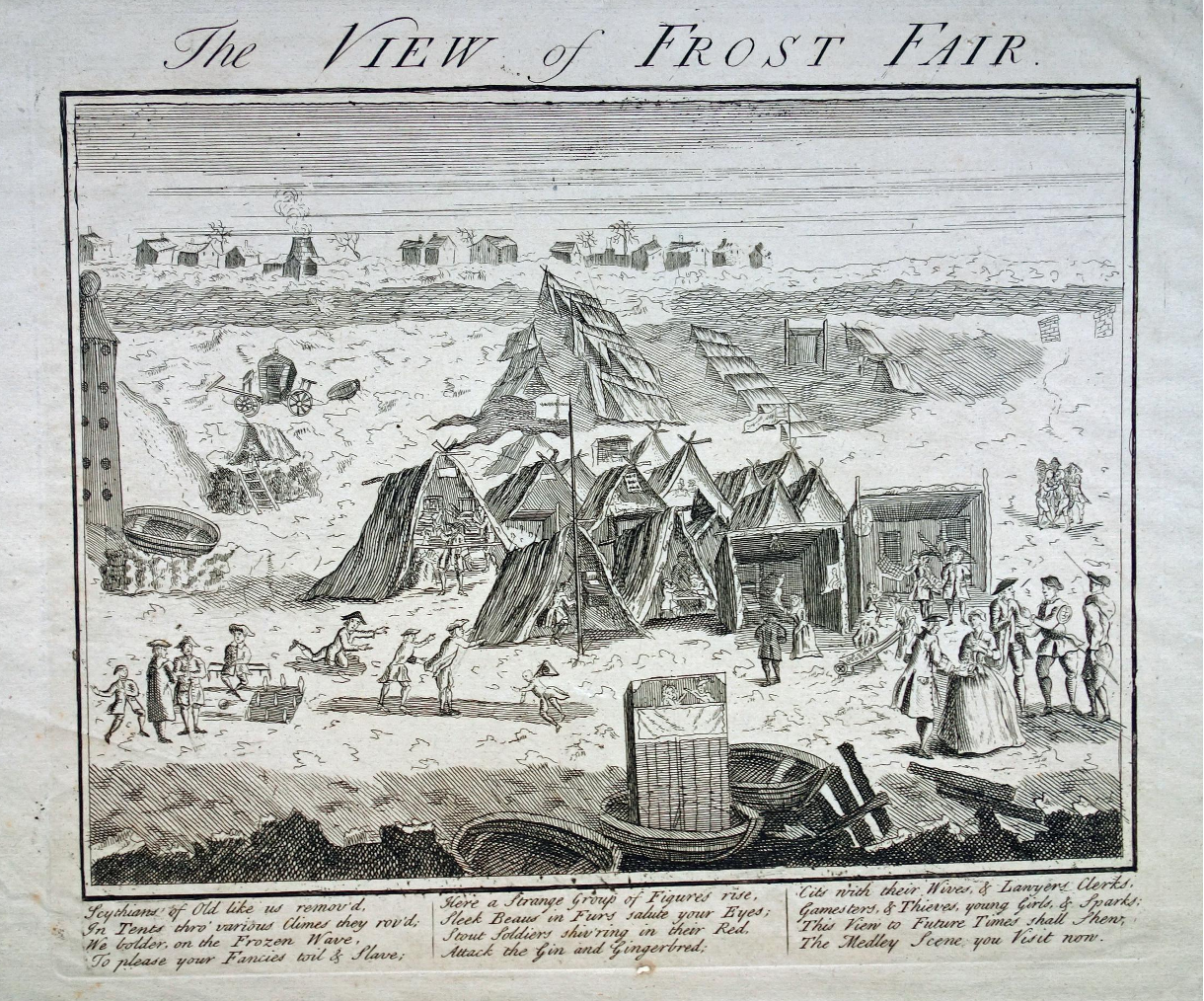
Winter fairs and temporary structures were set up on frozen Liffey and Thames rivers.
‘View on the Thames during the Frost Fair of 1739-40; a number of tents and booths on ice; people playing skittles on the left a group of men in discussion on the right, in the foreground a Punch and Judy show inside a boat. 1740’. The Trustees of the British Museum.
Food rioting in Ireland was ongoing throughout the remainder of the century. Ireland recorded moderate to severe drought years in 1740-42, 1761-62, 1779-81, 1784-87, 1793-4 and 1799; each period, witnessed a cycle of food scarcity, rising vagrancy and property crimes, rioting and fears of political instability, concluding with a police reform. A series of Dublin parish watches acts were passed in or around the severe weather events in 1740, 1750 regulating high and petty constables in the capital, 1763/4 and 1766, and again in the 1780s and 1790s, making it no coincidence.
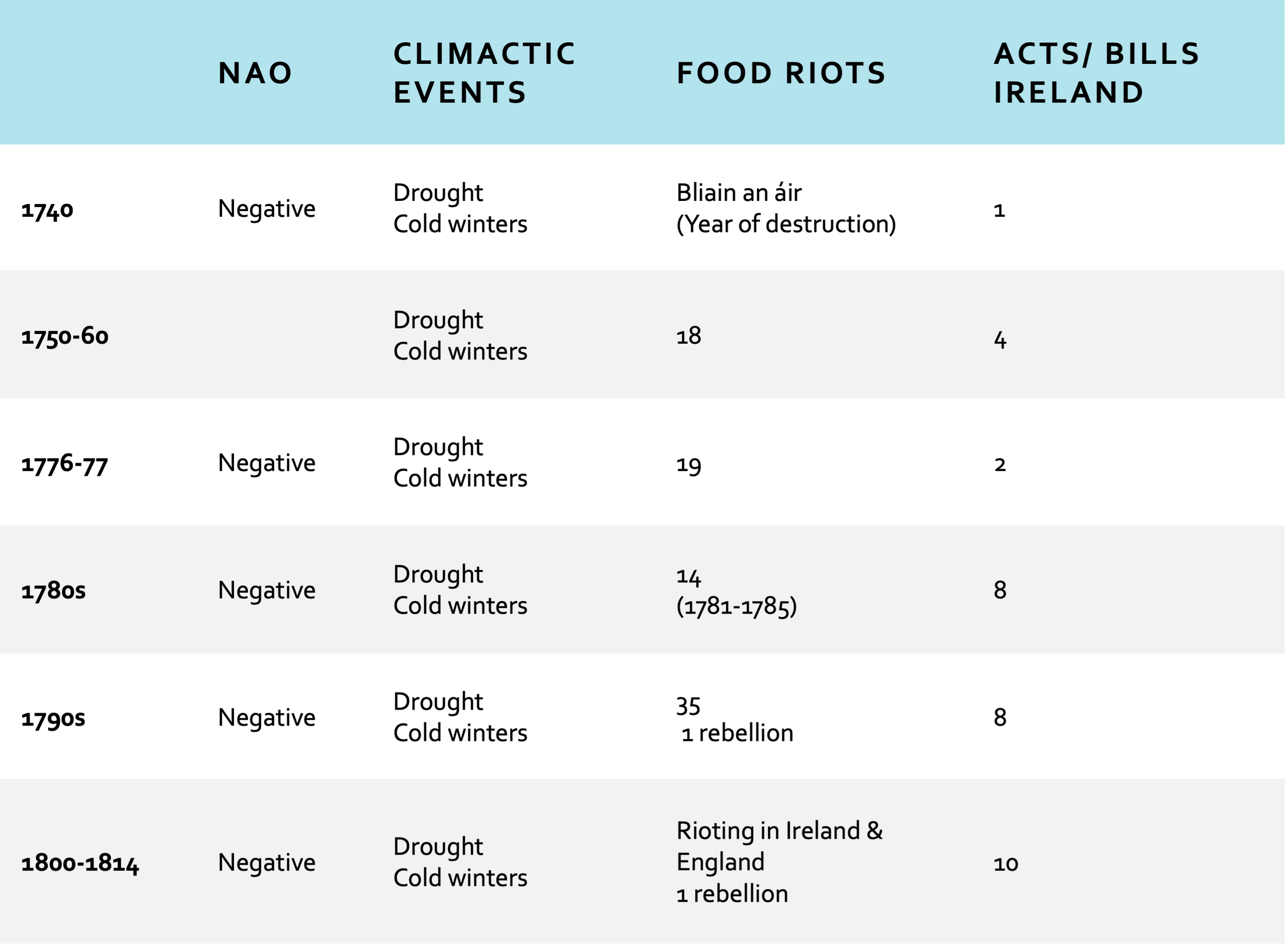
Climactic events, rioting and
Law Enforcement (Ireland)
Fears of social and political unrest in Ireland were intensified by its colonial status and penal laws. In 1784, Ireland was in its second year of subsistence crisis, with Dublin affected worse than other areas. The capital suffered torrential rains, flooding, influenza outbreaks, and rising unemployment.The Irish harvests were further crippled by two subsequent severe winters. Liffey, like the Thames, froze. In 1786, the country was still struggling with the persistent cold, as frost and severe weather continued late in the season. The worsening subsistence crisis resulted in escalating food rioting and property crime.
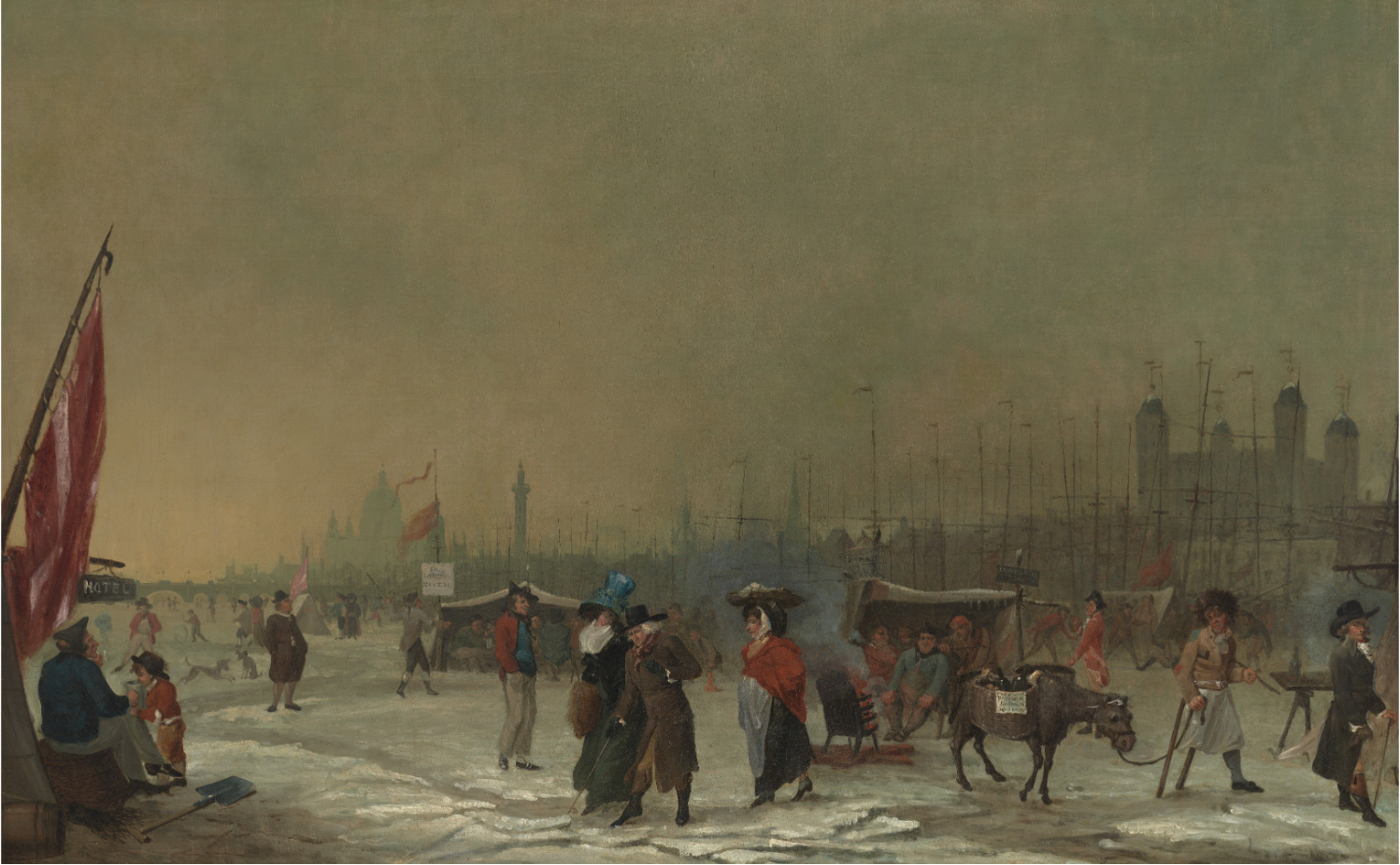
Frost on the Thames, 1788 to 1789 by Samuel Collings. Oil on canvas, Yale Center for British Art, Paul Mellon Collection, B1976.7.99.
City’s crime watch establishment was beginning to show cracks under the strain of growing city population due to urban migration, food shortages and social unrest. The same year, on 20 March 1786, Rutland’s administration presented a new Dublin police bill, which used the preceding year’s failed London police bill as a blueprint, establishing the first organised day police.
With more severe droughts in 1793-4 and 1799, core crops like wheat, oats and potatoes increased in price by 300 to 500 per cent between 1796 and 1805. The lagging wages and high food prices substantially worsened the subsistence crisis of the mid-1780s. By 1793, the provisions ascended to ‘monstrous price’ and ‘was more than “the poor industrious manufacturers … [and] lower orders of the public in general” were willing to tolerate.’ Crowds from the Liberties targeted retailers and merchants, with ‘carts conveying grain and other commodities to the capital… intercepted.’
“London police were new, though the concept was not.”
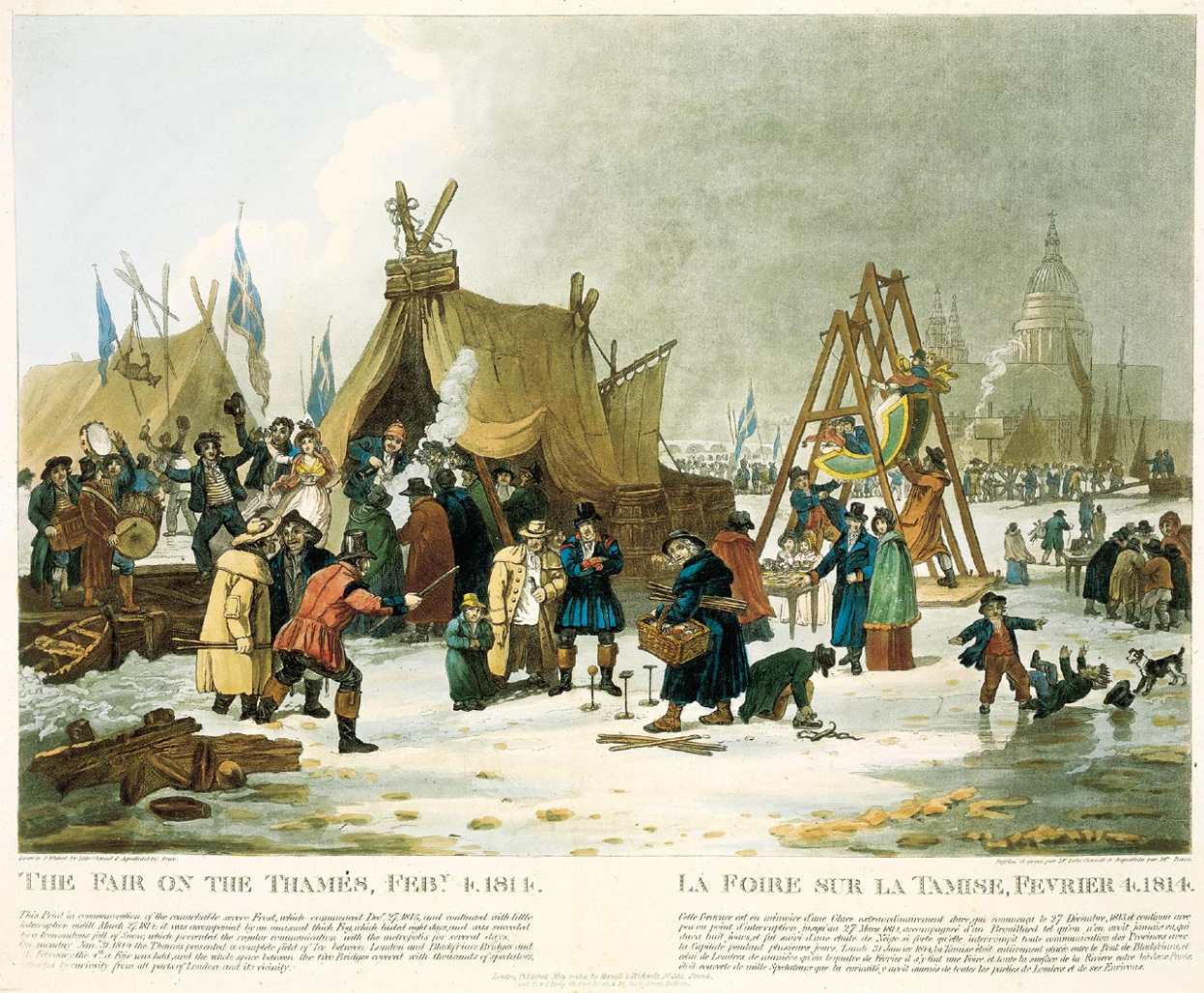
The Frost Fair of 1814 by Luke Clenell.
In 1811, the Thames froze during winter. Cold winters led to hunger and price fixing rioting throughout the country. The river iced over again in 1813-14, 1826, and again in 1829-30. The year the 1816 Westminster police inquiry took place was known as the ‘year without summer’. By the 1820s, England has experienced nearly a decade of ‘the cold years’, from 1812 to 1820, which ‘coincided with a cycle of poor grain and potato harvests, food scarcities, and rapidly rising commodity prices in societies that were already unsettled by changing economic conditions at the end of the Napoleonic wars.’ In contrast to the frenzy of police bills for Dublin, London policing evolved through the parliamentary committees and reports, with nine reports published between 1812 and 1838. The Metropolitan Police Act 1829 was not conceived in isolation, however, building on preceding Dublin police reforms and widespread experimentation in urban policing legislation across the cities in the British Isles. London police were new, though the concept was not.
Further reading:
[1] Global Land Surface temperatures show cooler winters with anomalies varying from -1 to -4.5 degrees, and consistently especially cold March (https://berkeley-earth-temperature.s3.us-west-1.amazonaws.com/Global/Complete_TAVG_complete.txt)
[2] Old World Dry Atlas, Ireland 1700-1900 timeseries http://drought.memphis.edu/OWDA/TimeSeriesDisplay.aspx
[3] Costello, et al, ‘Adapting to the Little Ice Age in Pastoral Regions: An Interdisciplinary Approach to Clime History in North–West Europe’ , Historical Methods: A Journal of Quantitative and Interdisciplinary History, vol. 56, no. 2 (2023), pp. 77-96.
[4] ‘Little Ice Age’, Encyclopaedia Britannica, https://www.britannica.com/science/Little-Ice-Age; Brian M. Fagan, Little Ice Age: How Climate Made History, 1300-1850 (Hatchett, 2020).
[5] James Kelly, Food Rioting in Ireland in the Eighteenth and early Nineteenth Centuries: The ‘Moral Economy and the Irish Crowd (Four Courts Press, 2017).
[6] James Kelly, ‘Climate, weather and society in Ireland in the Long Eighteenth Century: The Experience of the Later Phases of the Little Ice Age’, Proceedings of the Royal Irish Academy: Archaeology, Culture, History, Literature, vol. 120 C (2020), pp. 273–324.
[7] 6 April 1784, Parliamentary Register: Or History of the Proceedings and Debates of the House of Commons of Ireland, Vol. 3, (Dublin: P Byrne and W Porter), p. 145.
[8] James Kelly, ‘Scarcity and Poor Relief in Eighteenth-Century Ireland’, in Eighteenth-Century Ireland: The Subsistence Crisis of 1782–4’, Irish Historical Studies, vol. 28, no. 109 (May 1992), pp. 38–62.
[9] Liam Kennedy and Martin W Dowling. ‘Prices and Wages in Ireland, 1700-1850.’ Irish Economic and Social History, vol. 24 (1997), pp. 62-104.
[10] Robert Barry Rose, ‘Eighteenth Century Price Riots and Public Policy in England,’ International Review of Social History, vol. 6, no. 2 (1961), pp. 277-292.